

Virtual laboratories
3D Virtual Pharmacy Labs
Four laboratories, each with its own practicals. Walk up to the bench, handle the apparatus, make the measurements yourself — and get a report built from what you actually did.
Choose a laboratory
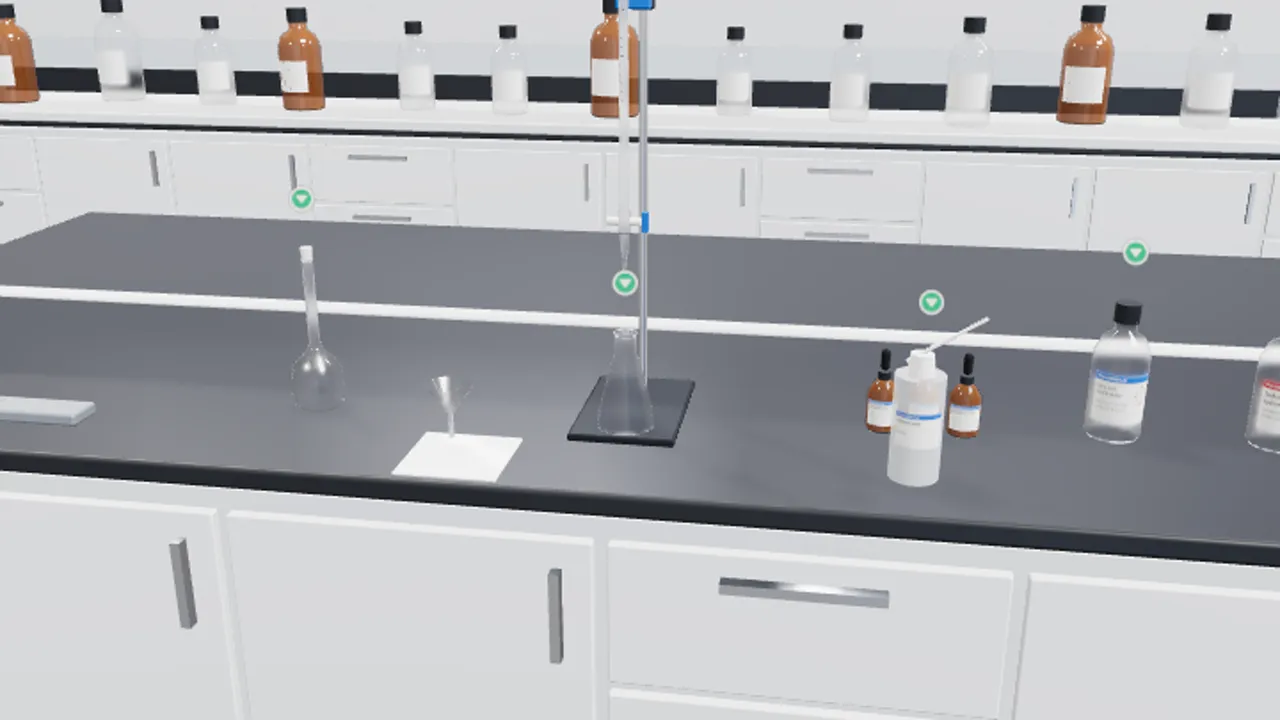
1 experiment
Pharmaceutical Chemistry Laboratory
Pharmaceutical Analysis
- Assay of citric acid by acid–base titrationWeigh a sample on an analytical balance, make it up in a volumetric flask, pipette an aliquot and titrate it with standardised sodium hydroxide to a phenolphthalein end-point — then calculate the assay from your own readings.~30 minIntermediateSyllabus source verified
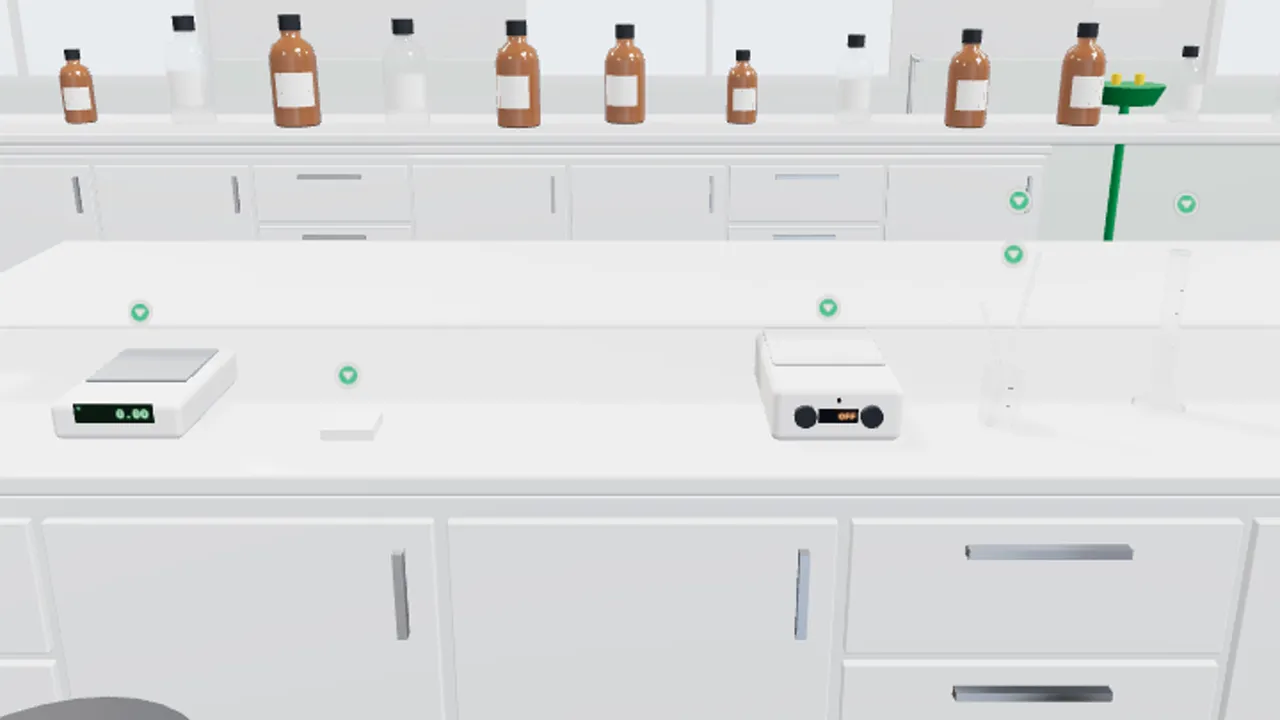
4 experiments
Pharmaceutics Laboratory
Physical Pharmacy
- Pharmaceutical solution preparation & dilutionCalculate the mass of solute for a stated concentration, weigh it on an analytical balance, dissolve and transfer it quantitatively to a volumetric flask, make up to the mark, then prepare an accurate dilution with a bulb pipette — and verify both concentrations.~25 minIntroductorySyllabus source verified
- Physical properties of liquids — density, viscosity, surface tensionThree connected activities in one practical: determine density and specific gravity with a pycnometer, relative viscosity with an Ostwald viscometer, and surface tension by capillary rise — each against water at a controlled temperature.~35 minIntermediateSyllabus source verified
Physical Pharmacy & Biopharmaceutics
- Solubility & dissolution studiesSaturate a solvent with excess drug at a controlled temperature, filter and evaporate an aliquot to find the solubility; then run a paddle dissolution test, withdraw samples on time, read them on a spectrophotometer and build the dissolution profile with the sampling correction.~40 minIntermediateSyllabus source verified
Pharmaceutical Dosage Forms
- Preparation and evaluation of Simple SyrupCalculate the formula for your batch, tare and weigh the sucrose, dissolve it in purified water with gentle heat and stirring, make up to volume when cool, pack, label and evaluate it — with a batch record of everything you did.~25 minIntroductorySyllabus source verified
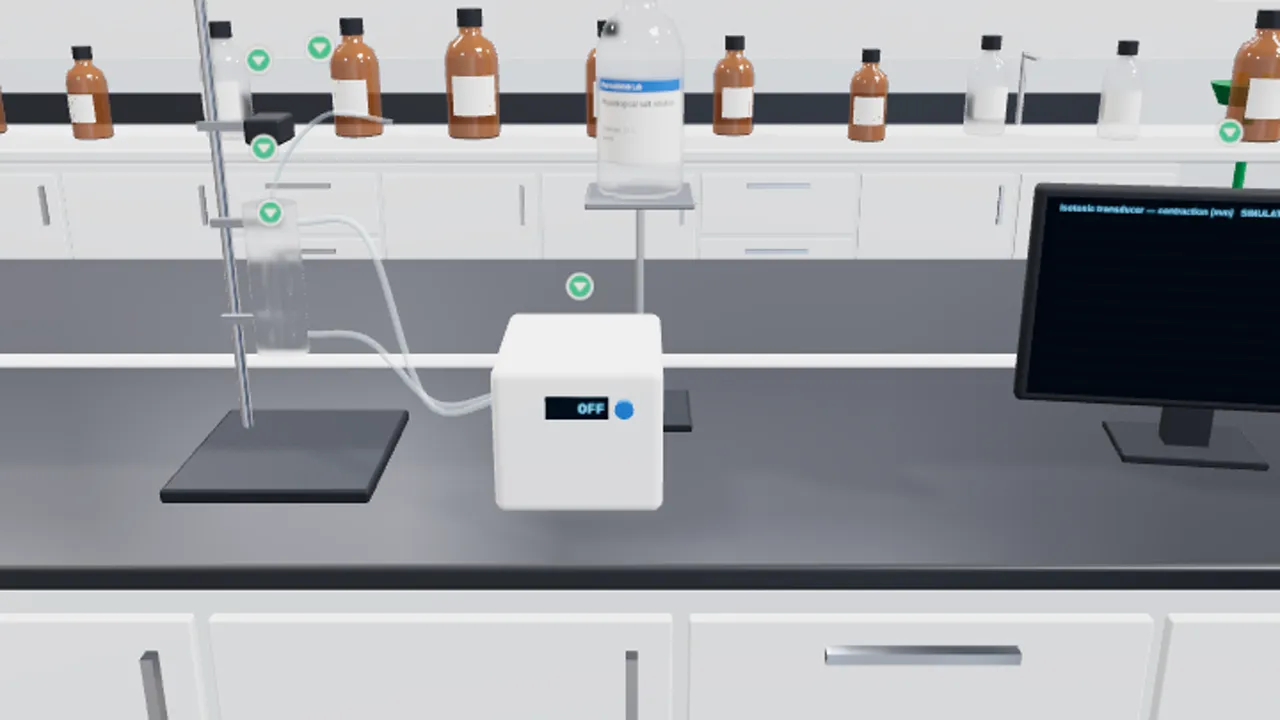
1 experiment
Pharmacology Laboratory
Pharmacology
- Graded dose–response curve (simulated isolated tissue)Set up a simulated isolated-tissue organ bath, add an agonist at concentrations you choose, record the contractions, wash between doses, and plot the graded dose–response curve on linear and logarithmic axes to find Emax and EC50.~25 minIntermediateSyllabus source verified
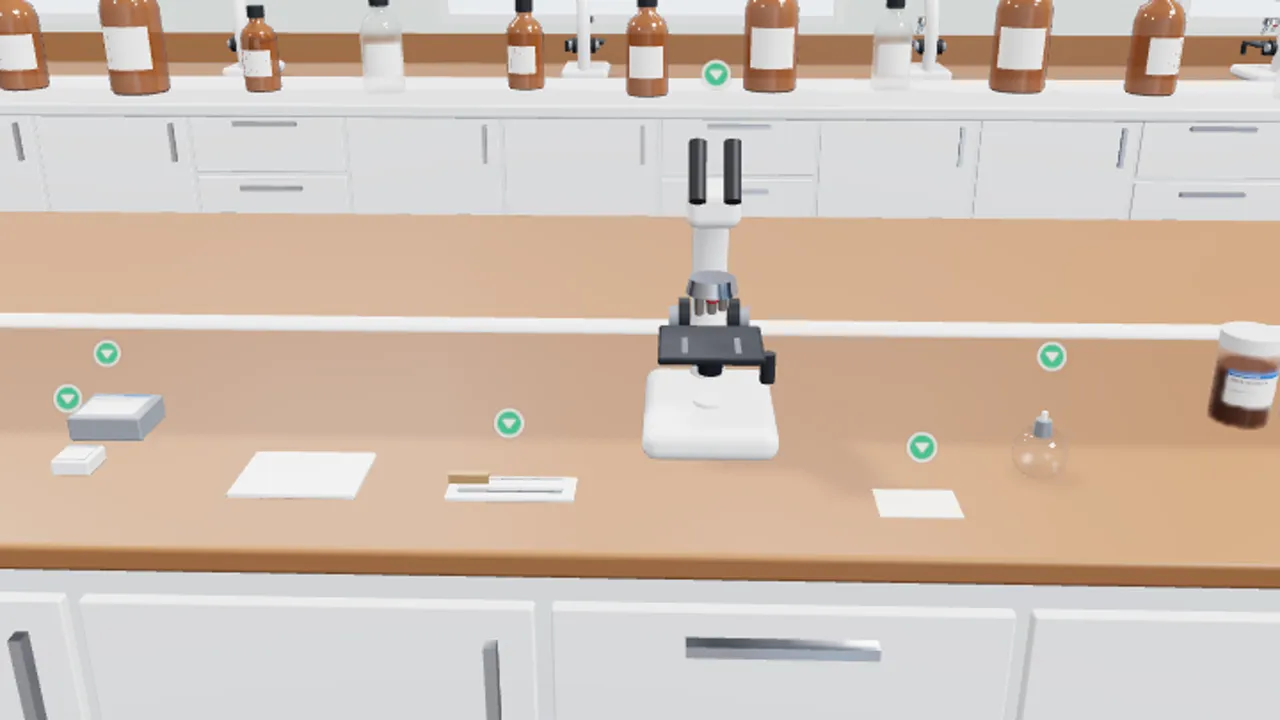
1 experiment
Pharmacognosy Laboratory
Pharmacognosy
- Microscopical identification of powdered cloveSelect the crude-drug sample, mount it in chloral hydrate, place the slide on a compound microscope, focus at low and high power, scan the field for diagnostic elements and identify the drug with the evidence that supports it.~25 minIntroductorySyllabus source verified
How these labs work
You do the practical. Choose the apparatus, weigh, measure, read the burette or the recorder yourself. Every number in your report comes from your own readings, and mistakes carry through to the result — with an explanation of why.
Walk, or be guided. Explore the room in first person, or let the camera take you to each station. Every action is also a button in the side panel, so the labs work with a keyboard, a screen reader, or on a device without 3D graphics.
Honest about what is simulated. Samples, purities and responses come from documented teaching models and illustrative data — not real patients or animals. Curriculum badges say exactly how far each mapping has been checked; none has yet been reviewed by faculty.
Credits and sources
The rooms, furniture, glassware and instruments are original procedural models built for PharmaWallah. Openly licensed assets used:
- Interior Tiles — Charlotte Baglioni (Poly Haven), CC0 1.0. Not required (CC0); credited as a courtesy.
- Beige Wall 001 — Dimitrios Savva, Rico Cilliers (Poly Haven), CC0 1.0. Not required (CC0); credited as a courtesy.
- Small Empty Room 3 (HDRI) — Sergej Majboroda (Poly Haven), CC0 1.0. Not required (CC0); credited as a courtesy.
- Oil glands of clove powder under light microscope — آية تاج الدين (Wikimedia Commons user), CC BY-SA 4.0. Photo: آية تاج الدين, Wikimedia Commons, CC BY-SA 4.0 — shown with its credit under the image. (Awaiting confirmation by a subject reviewer.)
Curriculum references: University of Karachi Pharm-D practical syllabi (Departments of Pharmaceutical Chemistry, Pharmaceutics, Pharmacology and Pharmacognosy) and the HEC Pharm-D curriculum (2025). Each lab’s briefing quotes the exact entry it maps to.